Dayedge's evening reader / Make an evening
A view you can stay beside.
A way home you know.
Start close to home. The best first place is one you can use comfortably, leave easily and understand before the light changes.
You do not need a western panorama. A view of sky above a street, a courtyard wall or trees outside a window can give you something to follow. Choose a place where observing does not compete with finding your footing or working out how to get back.
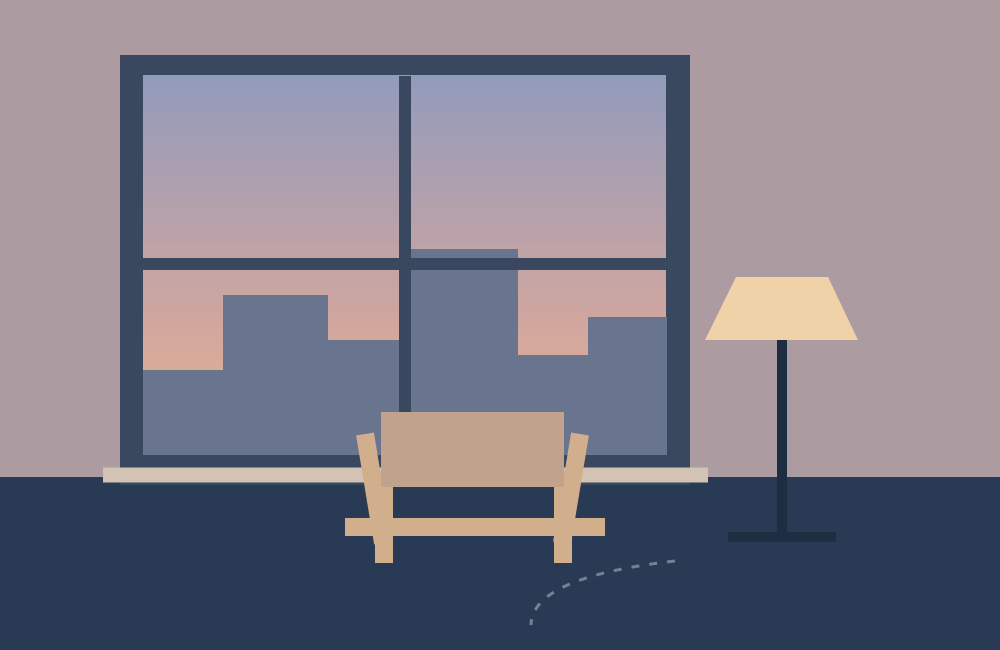
Try the window first.
A window lets you notice the evening without arranging a journey. Choose a seat with a view you can comfortably see. If a room light creates a reflection, change your position before deciding to dim it; keep enough light for anyone moving through the room.
In one imagined example, a reader faces a courtyard rather than the sunset. They notice the pale wall turning grey and a neighbouring window becoming prominent. The view is ordinary, but the transition is visible. A panoramic sunset would not make this experience more valid.
For a bench, visit before dusk.
Check the seat, the surface around it and the route back while it is light. Find out whether the space closes at a set time. If a gate shuts or a path becomes difficult after dark, choose an earlier finish or a different place.
Imagine a park bench with a beautiful open view but an unlit, uneven exit path. The view is appealing; the return is the deciding detail. A seat by a familiar, lit route may be the better first choice. Bring a usable light when you need one. There is no rule that you must sit in complete darkness.
Make the invitation specific.
“Let's watch dusk” leaves several questions unanswered. Say where to meet, whether there is seating, what the route is like, how long you expect to stay and what happens if the weather changes. Ask what would make the place usable for the people joining you; do not assume that a short walk or a low chair works for everyone.
Keep the plan easy to leave. A suggested finish is useful, and so is permission to leave sooner. Some people may want quiet; others may want to talk. Agree on that before the evening rather than treating silence as a test of doing it correctly.
Original wording · replace the brackets
An invitation you can use
Would you like to watch the evening change with me?

Meet at [specific place and meeting point] on [date] at [local time and time zone].

We will sit and notice the light changing. The plan is to finish around [time], and you can leave earlier.

Seating and access: [describe the seat, route and any steps].
If the weather changes: [indoor option or how we will cancel].

Let me know what would help you join comfortably. Reply to [your usual contact]. No equipment or experience needed.
This is a template, not an advertised event. Replace every bracket before sharing it. Keep private addresses in a direct invitation rather than a public page.
If you put your invitation online.
Open the published page as a visitor, without your editing session. Check that the meeting point, local time, access notes and cancellation route remain easy to find on a phone. Keep the page useful if someone cannot or does not want to submit a form.
WebTraceCheck is an optional browser tool for checking that visitor journey. If your own invitation site sends a non-sensitive test confirmation, CleanTempMail provides a disposable test inbox. Use your usual reliable address for actual guests, replies and cancellation messages; a temporary inbox is not an event contact or account recovery address.
Both products and Dayedge share the MoneyHunter operator. You can use your own browser and test inbox. Neither is required to go dusking, and this guide does not send invitations.
Leave room for an ordinary evening.
Cloud may hide the colour you expected. A street may stay bright. Conversation may turn out to matter more than the sky. The plan is a chance to pay attention together, not a promise of a spectacular scene or a particular mood.
If the place becomes uncomfortable, change it or finish. You can try a different window or an earlier time another day.