Dayedge's evening reader / Read the light
Sunset is a moment.
Twilight is a passage.
A sunset time is a useful reference, but it does not mean the sky goes dark at that minute. The labels below describe the Sun's position. What you can actually see also depends on the place and the weather.
The Sun disappears, but its light still reaches the atmosphere above you. That interval after sunset is twilight. It is a transition you can watch, rather than a switch from a bright sky to a black one.
For a clear, unobstructed horizon, sunset is when the Sun's visible disc disappears. A building or hill can hide it from your seat earlier. The local sunset time and the moment you lose sight of the Sun therefore need not match.
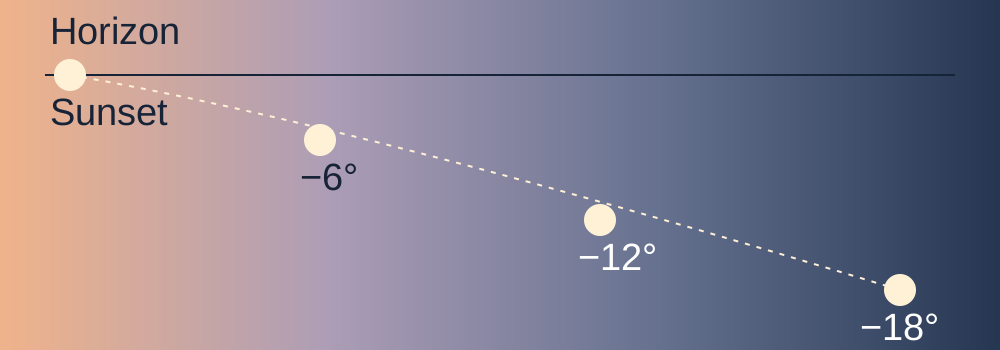
The first interval is civil twilight, ending when the Sun's centre is 6° below the horizon. Then comes nautical twilight, ending at 12° below, followed by astronomical twilight, ending at 18° below.
Those labels help make a listing precise. They are not three appointments you must keep. You can stop before sunset or leave during the first interval; dusking has no finish line at −18°.
Angular definitions: US National Weather Service.
Degrees are not minutes.
“Civil twilight ends at −6°” does not mean it lasts six minutes. The Sun's path relative to the horizon changes with latitude and season. A fixed “twenty minutes after sunset” rule cannot describe every evening.
Likewise, the named stages are not promises about visibility. A cloudy sky, a bright road or an obstructed view can make your experience different from a simple diagram. Use a local sunset listing as a starting reference, then choose an end time that suits the place and your return.
Does “dusk” mean one exact time?
People use “dusk” loosely for the fading evening. Technical listings may specify civil dusk, nautical dusk or astronomical dusk: the end of the corresponding twilight stage. Check the label before comparing two times.
If you cannot see the Sun.
You can still notice the light changing from a window or a sheltered seat. Choose a broad view you can remain beside comfortably, rather than moving around to chase a gap between buildings.
For an imagined example, a courtyard faces away from the sunset. The viewer never sees the solar disc, but can watch a pale wall lose colour and the sky above it darken. That is a useful dusking experience; it is not a measurement of sunset or evidence about what tomorrow will look like.
There is no need to look directly at the Sun. Observe the wider sky and surroundings. Turn on a light or leave whenever you need to; keeping a path visible matters more than preserving the atmosphere of the moment.
An original observation exercise
The same window.
Two different evenings.
It is easier to compare a place when you give your attention something to return to. Choose three ordinary features: a pale wall, a branch against the sky and an unlit surface nearby. Look at them from the same comfortable seat. You do not need an instrument, a photograph or a spectacular sunset.
The entries below are invented to show the difference between an observation and an explanation. They are not field measurements or a forecast for a named location.
First evening. The pale wall still has a warm edge. The branch is easy to separate from the sky. I can see the shape of the empty chair in the courtyard, but not its slats. A window opposite has just become brighter than the wall beside it.
This entry stays close to what the reader noticed. “The window became brighter than the wall” is a comparison; “someone switched on a lamp at sunset” is a story about its cause. The lamp may already have been on. Without watching the switch, the reader cannot know.
Second evening. Cloud hides the colour I remember. The branch stands out sharply, but the courtyard wall looks flat. The opposite window catches my attention sooner. I finish when I want the room light on, without waiting for the same view as yesterday.
Neither evening is a failed version of the other. Keeping the same view reveals a difference without requiring a reason for every change. Write “cloud across the visible sky” when that is what you saw, rather than turning one grey evening into a claim about all cloudy sunsets.
Write one sentence you could recognise again.
“It was beautiful” can be a true personal response, but it gives tomorrow’s reader little to look for. Try “the fence stopped showing separate boards before the branch lost its outline”. You can still add how it felt; keep the visible detail beside the feeling rather than asking one to stand in for the other.
If you record a time, include the date and local time zone. Label a listed sunset time as a listing, and label the moment a roof hid your view as your own observation. A building’s edge and the astronomical horizon are different references, as the explanation above shows. Do not turn the difference between them into a claim that a forecast was wrong.
Let a photograph be a keepsake.
A phone picture is useful for remembering the framing. It is not automatically a calibrated record of the brightness you experienced. Keep your short written comparison as well, especially if the phone changes how bright the scene looks between shots. Put the device away if taking pictures is distracting you from the evening you came to watch.
For a first attempt, one arrival sentence and one leaving sentence are enough. There is no required interval, score or minimum time. Stop while the place and journey still work for you. Choose the seat and return route before making the observation into an outing.